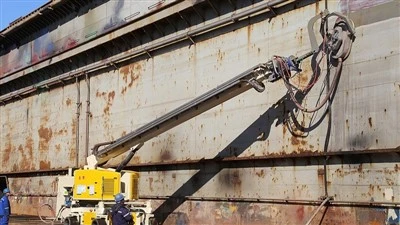
As a supplier of Dock Bottom Work Vehicles, I've had the privilege of witnessing firsthand the critical role these machines play in the maritime industry. One of the most crucial aspects of operating a Dock Bottom Work Vehicle is the visibility the operator has. In this blog, I'll delve into the various types of visibility operators can expect and how it impacts the efficiency and safety of dock bottom operations.
Natural Visibility Challenges
The working environment of a Dock Bottom Work Vehicle presents numerous challenges to natural visibility. Dock bottoms are often dimly lit areas, with limited natural light penetration. The presence of water, which can cause glare and reflections, further complicates the operator's view. Additionally, the docking area may be filled with various obstacles such as mooring lines, debris, and other equipment, obstructing the operator's line of sight.
To overcome these challenges, Dock Bottom Work Vehicles are equipped with large, well-placed windows and mirrors. These features are designed to provide the operator with a wide field of view, both inside the vehicle and around it. The windows are made of high-strength, impact-resistant glass, ensuring clear visibility even in harsh conditions. The mirrors are strategically positioned to minimize blind spots and provide a comprehensive view of the vehicle's surroundings.
Camera Systems
In recent years, camera systems have become an essential part of Dock Bottom Work Vehicles. These systems complement the natural visibility provided by windows and mirrors, offering additional perspectives and enhancing the operator's situational awareness.
Modern Dock Bottom Work Vehicles are typically equipped with multiple cameras, placed strategically around the vehicle. These cameras can cover areas that are difficult to see directly, such as the rear, sides, and bottom of the vehicle. The camera feeds are displayed on monitors inside the operator's cabin, allowing the operator to have a real-time view of the surroundings.


One of the key advantages of camera systems is their ability to provide visibility in low-light conditions. Many cameras are equipped with night vision technology, which uses infrared light to illuminate the area and capture clear images even in complete darkness. This is particularly useful for operations that take place at night or in areas with limited lighting.
Another benefit of camera systems is their ability to zoom in and focus on specific areas. This feature allows the operator to get a closer look at objects or areas of interest, such as rust spots or damage on the dock bottom. Some camera systems also offer panoramic views, providing a 360-degree view of the vehicle's surroundings.
Sensor Technology
In addition to camera systems, Dock Bottom Work Vehicles are also equipped with various sensor technologies. These sensors can detect obstacles, measure distances, and provide information about the vehicle's position and orientation.
Ultrasonic sensors are commonly used to detect obstacles in the vehicle's path. These sensors emit high-frequency sound waves and measure the time it takes for the waves to bounce back from an object. Based on this information, the sensor can calculate the distance between the vehicle and the object. If an obstacle is detected within a certain range, the sensor will trigger an alarm, alerting the operator to take action.
Laser sensors are another type of sensor commonly used in Dock Bottom Work Vehicles. These sensors work by emitting a laser beam and measuring the time it takes for the beam to reflect back from an object. Laser sensors are more accurate than ultrasonic sensors and can provide a more detailed map of the vehicle's surroundings. They are often used for precision operations, such as docking and maneuvering in tight spaces.
Inertial measurement units (IMUs) are also used in Dock Bottom Work Vehicles to provide information about the vehicle's position, orientation, and motion. IMUs consist of accelerometers, gyroscopes, and sometimes magnetometers, which measure the vehicle's acceleration, angular velocity, and magnetic field, respectively. By integrating the data from these sensors, the IMU can calculate the vehicle's position and orientation in real-time. This information is used by the vehicle's control system to ensure stable and accurate operation.
Augmented Reality (AR) and Virtual Reality (VR)
The use of augmented reality (AR) and virtual reality (VR) technologies is becoming increasingly popular in the maritime industry, including in Dock Bottom Work Vehicles. These technologies can provide the operator with additional information and a more immersive experience, enhancing their visibility and situational awareness.
AR technology overlays digital information onto the operator's view of the real world. For example, an AR system could display the location of nearby obstacles, the vehicle's path, and other relevant information directly on the operator's windshield or a heads-up display. This allows the operator to keep their eyes on the road while still having access to important information.
VR technology, on the other hand, creates a completely virtual environment for the operator. This can be useful for training purposes, allowing operators to practice operating the Dock Bottom Work Vehicle in a safe and controlled environment. VR can also be used during actual operations to provide the operator with a more immersive view of the surroundings, especially in areas where visibility is limited.
Impact on Efficiency and Safety
The visibility the operator has in a Dock Bottom Work Vehicle has a significant impact on both the efficiency and safety of operations. Good visibility allows the operator to accurately judge distances, identify obstacles, and maneuver the vehicle with precision. This can lead to faster and more efficient operations, reducing the time and cost required to complete dock bottom maintenance and repair tasks.
In terms of safety, good visibility is essential for preventing accidents and collisions. By being able to see clearly, the operator can avoid hitting obstacles, other vehicles, or workers in the area. Additionally, camera systems and sensor technologies can provide early warnings of potential hazards, giving the operator more time to react and take appropriate action.
Our Product Offerings
At our company, we are committed to providing the highest level of visibility for operators of our Dock Bottom Work Vehicles. Our vehicles are equipped with state-of-the-art camera systems, sensor technologies, and other features designed to enhance visibility and situational awareness.
We offer a range of Dock Bottom Work Vehicles, including the Dock Bottom Rust Removal Vehicle, Ultra-High-Pressure Water Jet Cleaning Vehicle, and many more. Each of our vehicles is designed to meet the specific needs of our customers and provide the best possible performance in dock bottom operations.
In addition to our Dock Bottom Work Vehicles, we also offer the Hull High-Reach Rust Removal Robot and Deck Rust Removal Vehicle, which are designed to remove rust and other contaminants from the hull and deck of ships. These robots are equipped with advanced camera systems and sensor technologies, providing the operator with excellent visibility and control.
Contact Us
If you are interested in learning more about our Dock Bottom Work Vehicles or other products, please do not hesitate to contact us. We would be happy to discuss your specific needs and provide you with a customized solution. Our team of experts is available to answer your questions and guide you through the purchasing process.
References
- Maritime Industry Journal: "Enhancing Visibility in Dock Operations"
- International Association of Maritime Operators: "Best Practices for Dock Bottom Work Vehicle Safety"
- Journal of Marine Technology: "The Role of Camera Systems in Dock Bottom Work Vehicles"